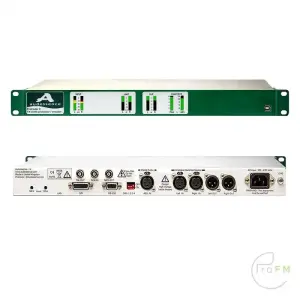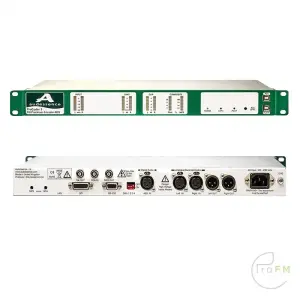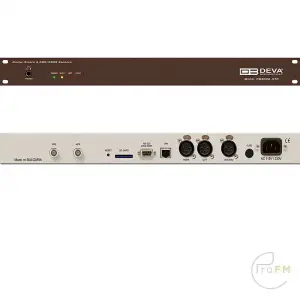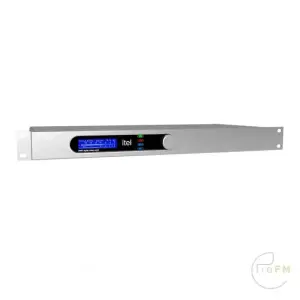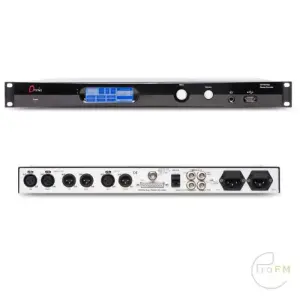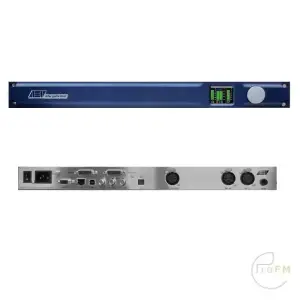
AEV Stargate EVO Stereo & RDS Encoder
€ 1.200,00 EX VAT


An FM stereo encoder converts left and right audio channels into a composite multiplex signal for FM radio transmission. This process allows compatible FM receivers to reproduce stereo sound. A professional stereo encoder generates the required stereo information and pilot tone while maintaining compatibility with mono receivers. In addition, FM stereo multiplex technology enables radio stations to deliver two-channel audio through a single FM broadcast signal.
At ProFM Broadcast, we provide professional broadcasting equipment for radio stations, transmission facilities and broadcast engineers. Our FM stereo encoders category covers equipment designed for reliable stereo signal generation and integration with suitable FM transmission systems.
Whether you operate a local FM station or maintain a larger transmission network, correct stereo encoding is an important part of the broadcast signal chain. Therefore, choosing suitable equipment helps maintain consistent transmission quality.
Professional FM stereo encoders prepare left and right audio signals for transmission through an FM broadcasting system. They combine the audio information into a composite baseband signal that can be applied to a compatible FM exciter or transmitter.
The encoder performs stereo multiplexing while preserving compatibility with conventional FM radio receivers. As a result, listeners with stereo receivers can hear separate left and right channels, while mono receivers reproduce a combined audio signal.
Depending on the model, professional equipment may provide analogue audio inputs, digital audio connections or additional signal adjustment options.
For radio broadcasters, stable signal generation and accurate stereo performance are important considerations.
FM stereo encoding uses multiplexing to combine two audio channels into one composite signal. The resulting MPX signal contains the information required for stereo reception.
First, the encoder creates a sum signal, commonly known as L+R. This carries the combined left and right audio and provides compatibility with mono receivers.
Next, it generates a difference signal, known as L-R. This information is transmitted using double-sideband suppressed-carrier modulation centred on 38 kHz.
In addition, the encoder generates a 19 kHz pilot tone. The receiver uses this reference to recover the stereo subcarrier and reconstruct the original audio channels.
Consequently, compatible FM receivers can reproduce the intended stereo image from the transmitted multiplex signal.
FM stereo multiplex is the process of combining the mono-compatible audio component, stereo difference information and pilot tone into one composite signal.
In a conventional stereo broadcast, the L+R audio occupies the baseband region up to approximately 15 kHz. The 19 kHz pilot indicates the presence of stereo information.
Meanwhile, the L-R information occupies a higher-frequency region around the suppressed 38 kHz subcarrier. This arrangement allows compatible receivers to separate the audio channels.
The resulting composite signal is commonly referred to as MPX. It is supplied to a suitable FM exciter or transmitter for modulation onto the radio-frequency carrier.
Correct multiplex generation is essential for stereo separation, receiver compatibility and consistent transmission performance.
The 19 kHz pilot tone is an essential component of conventional FM stereo broadcasting. It provides the receiver with a reference for reconstructing the stereo difference signal.
A stereo receiver detects this pilot and uses it to regenerate a coherent 38 kHz reference. This enables the receiver to recover the left and right audio channels.
Accurate pilot frequency and phase relationships are therefore important for reliable stereo decoding.
Professional encoder designs aim to maintain stable pilot generation and correct alignment with the stereo multiplex components.
Stereo separation describes how effectively the left and right audio channels remain distinct after encoding and decoding.
Good stereo separation helps preserve the intended soundstage of music and other programme material. However, overall performance also depends on the transmitter, transmission path and receiving equipment.
Audio bandwidth, channel balance and phase accuracy can influence the final result. Therefore, careful system configuration is important.
Some professional encoders provide adjustments for audio levels, pilot injection or other operating parameters. Available functions vary between models.
In addition, the preceding audio processing chain should be configured appropriately for the FM transmission system.
A stereo encoder is normally installed between the programme audio source and a compatible FM exciter or transmitter.
The unit receives left and right programme audio and produces the composite signal required for stereo modulation.
For example, a radio station may connect its audio processing equipment to the encoder inputs. The MPX output can then feed the composite input of a suitable FM transmitter.
However, the connection method depends on the equipment. Input formats, output levels, impedance and connector types must be checked before installation.
Some modern FM transmitters already include internal stereo encoding. In those installations, an external unit may not be necessary.
FM stereo encoding and Radio Data System (RDS) encoding perform different functions within the broadcast signal chain.
The stereo encoder generates the multiplex components required for left and right audio transmission. An RDS encoder, by contrast, generates digital programme information that is typically carried on a 57 kHz subcarrier.
Depending on the equipment, RDS information may be added through a separate encoder or generated by an integrated broadcast processor.
Therefore, an FM stereo encoder does not automatically provide RDS functionality. Broadcasters should verify the available features and signal connections.
Correct integration helps maintain a suitable composite signal for the intended transmission system.
Stereo encoding can be provided by a dedicated standalone unit or integrated into other professional broadcasting equipment.
For example, some FM audio processors include stereo multiplex generation as part of their output stage. Certain FM exciters also provide built-in encoding.
A standalone encoder can be useful when the existing audio processor or transmitter does not include the required function.
It may also suit installations where broadcasters prefer separate components for audio processing, multiplex generation and RF transmission.
However, the best configuration depends on the equipment already installed and the station’s technical requirements.
Stereo multiplex equipment is used in a range of professional radio transmission environments. Its primary purpose is to prepare two-channel programme audio for compatible FM transmission.
For example, a station may use a dedicated encoder as part of an existing transmitter installation. Meanwhile, a broadcast engineer may use similar equipment when configuring or testing a stereo transmission system.
In each case, correct integration is essential for dependable operation.
When selecting an FM stereo encoder, first identify the available programme audio connections. The chosen unit must accept the required input format and signal levels.
Next, check the MPX output specifications and compatibility with the intended FM transmitter or exciter.
Also consider stereo separation, pilot accuracy and the available adjustment options. These characteristics can influence the performance of the complete broadcast chain.
Furthermore, determine whether the installation requires external RDS integration or additional multiplex inputs.
Finally, review the equipment’s installation requirements, power supply and operating controls before making a selection.
At ProFM Broadcast, we specialise in professional equipment for radio stations, broadcast engineers and transmission facilities.
Our selection of FM stereo encoders supports stereo multiplex generation for compatible FM broadcasting systems. Whether you are upgrading an existing installation or designing a new transmission chain, selecting suitable equipment is an important step.
Explore the available stereo encoding solutions and compare their technical specifications to find equipment that matches your broadcasting requirements.
Showing all 9 results



Protected by Security by CleanTalk